
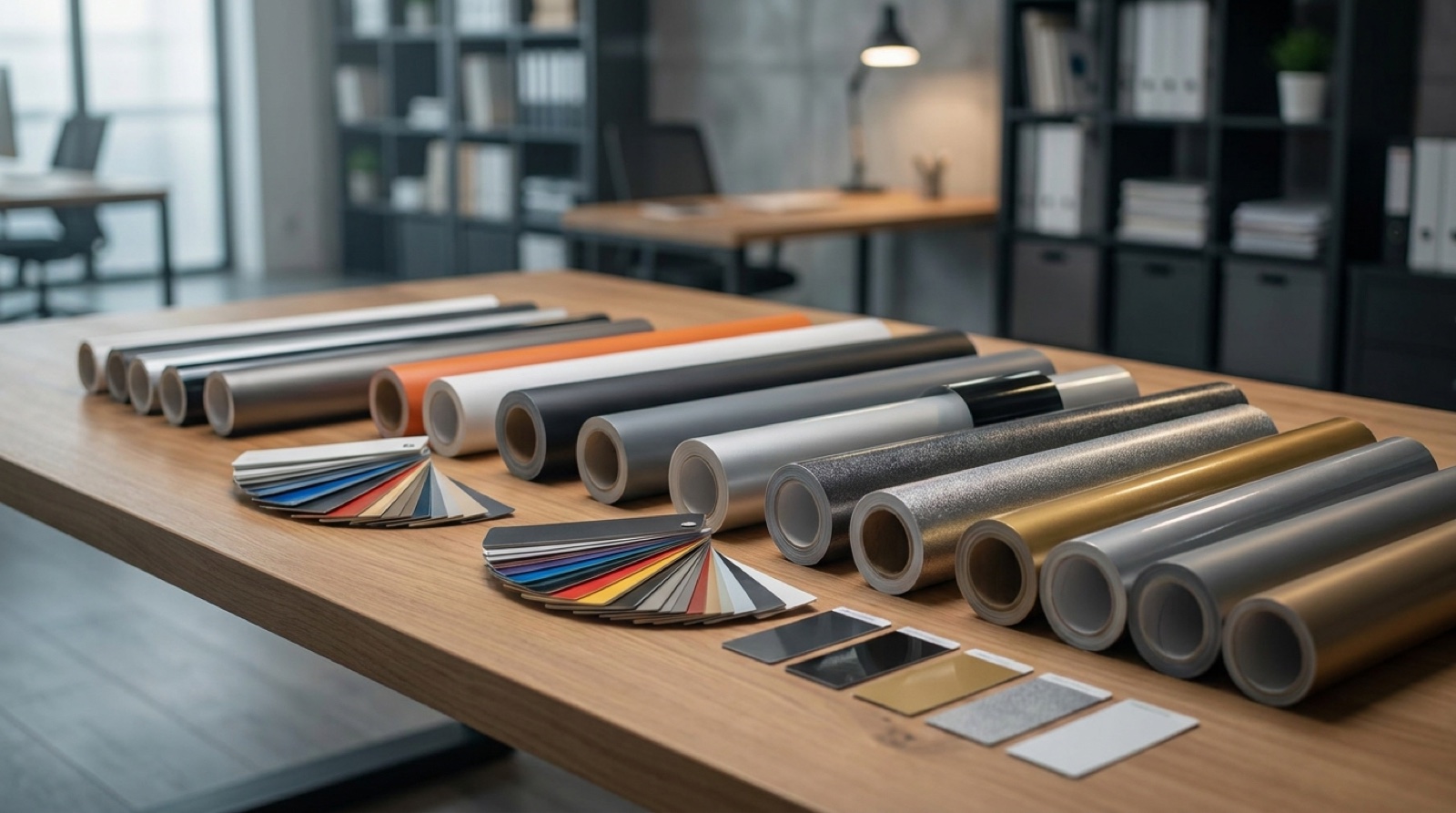
Pick the finish before you pick the color. The finish decides how the color reads in daylight, how much cleaning it demands, and how forgiving it is about swirl marks and dust.
A satin dark blue and a gloss dark blue are barely the same product in practice. One hides everything and asks little of you, the other looks wet and shows every fingerprint near the door handle.
Nearly every wrap sold falls into gloss, satin, matte, or a textured specialty film. Each behaves differently once it is on a real car parked outside in Oklahoma sun.
Gloss reads closest to factory paint, which is why it is the safest choice for a resale-minded owner or a leased vehicle. It reflects light hard, so body lines and curves look sharper.
The tradeoff is that it shows water spots and light scratching the same way paint does. If you liked how your paint looked when it was clean, a gloss film gives you that in a new color.
Satin sits between gloss and matte with a soft sheen and no mirror reflection. It is the most requested finish we install, and for good reason.
It hides dust and minor imperfections better than gloss while still showing shape and contour. Satin greys, satin blacks, and satin deep blues photograph extremely well, which matters if the car ends up on your social feed.
Matte kills reflection entirely and gives a flat, aggressive look. It makes a car look larger and more uniform, but it flattens body lines rather than emphasizing them.
Matte also demands the most from you as an owner. Its microtexture holds fuel splash, bug residue, and fingerprints, and those marks do not buff out the way they would on gloss. Read up on what a matte install involves before committing to it as a daily driver.
Chrome, brushed metal, color shift, carbon fiber, and forged carbon all live here. They are expensive, harder to install, and generally shorter-lived than standard cast films.
They work best on partial coverage. A chrome roof, a brushed metal hood, or accent panels get you the visual impact without the cost or maintenance burden of a full car in specialty film.
| Finish | Hides Dirt | Upkeep | Best For |
|---|---|---|---|
| Gloss | Poor | Low | Resale, leases, factory look |
| Satin | Good | Low | Daily drivers, most colors |
| Matte | Fair | High | Show cars, garage-kept |
| Chrome and color shift | Poor | Very high | Accents and partials |
Edmond summers put wraps through real stress. Surface temperatures on a dark hood in an uncovered lot off Broadway Extension climb well past what the ambient reading suggests.
Dark colors absorb more of that heat, and heat is what ages vinyl. A black or deep navy wrap on a car that lives outside year round will show fade and edge lift sooner than a white or silver one on the same vehicle.
That does not rule out dark colors. It means a garage or covered parking meaningfully extends the life of a dark wrap, and that reds and dark blues need a little more attention than mid-tone greys.
The other Oklahoma factor is wind and grit. Highway driving between Edmond and Yukon sandblasts the front end, so we often pair a wrap with clear film on high-impact areas.
Your intended use narrows the field faster than any color chart.
If the vehicle is doing work for you, legibility beats aesthetics. Our work on service vehicles almost always starts with a light base color and high-contrast graphics rather than the color the owner personally likes best.
A full color change means every visible panel, including door jambs if you want it done properly. It is the right call when you want the car to read as a different vehicle.
Partials cost less and can be more effective. Blacking out the roof, wrapping the hood, or removing bright trim with a chrome delete changes a car's character for a fraction of a full wrap.
Two-tone builds are also popular right now. Satin black roof and pillars over a gloss body color is a clean combination that works on nearly any sedan or SUV.
Color swatches on a screen lie. Monitor calibration, lighting, and photo editing all shift how a film looks, and satin especially never translates to a screen.
Bring your vehicle to our shop on Linda Lane and hold physical samples against your own panels in daylight. Colors read differently depending on the body shape and the paint underneath.
We will also tell you honestly if a film you like is a poor match for how you drive. If you are weighing a couple of options, get in touch for a quote and we will walk through samples and pricing with you.
Once the finish is decided, the rest is straightforward. Every custom wrap we build starts with that one choice, and getting it right is the difference between a car you keep clean and one you stop looking at.
See The Colors In Person
Bring your vehicle to our Edmond shop and compare real film samples against your own paint in daylight.